Another Sighting

The old farmhouse is falling to ruin.  A screen door dangling by a hinge.  Slabs of plaster and lathe in the tub.  Swallows swooping up the staircase, chittering from mud-baked igloos.  Blue sky yawning from the bedroom ceiling. 

But down in the kitchen, next to the crater where the sink used to be, Elvis croons on, undeterred, standing next to a discarded drain stopper and a jar of ancient molasses, his voice smoky yet smooth, brown, sweet. 

Dust accumulates.  From dust to dust.  Eventually even a legend must drift down, taking his follies with him: the bellbottom trousers and greased hair, the patent shoes and cape.  We all take this turn, becoming outdated as the canned preserves in the basement cellar.  Pickles yellowing in hazy jars.  Pickles that might still be crisp, though no one will know. 

For a little while longer, though, there is that low velvety voice in the kitchen: Love me tender, love me sweet . . . 

Elvis closes his eyes, but he croons on—never let me go.

In Praise of Wildflowers

Not tame, they grow out of bounds—outside the rules that humans would put on them.  Beautiful but hardy, they are found in the most unexpected places.  Suddenly blooming on the sandy hardpan of a desert floor, surrounded by thorns.  Dotting the dusty tallgrass prairie.  Or scrabbling along a rocky scree above timberline, where the snow is never quite gone.  Saxifrage, they call these tiniest of alpine blossoms—or “stone breakers”—because they literally lodge in the cracks of granite and, over centuries, help to shatter it. 

Some are quite rare, and some so “common” they carry that very label. “Common Mullein,” for example, with its grey-green, velvety leaves and its tall stalk of lemon-yellow blossoms.  Pliny described that abundant flowerer in ancient Italy, where Romans dipped the woody stem in grease and, at night, turned it into a more fiery blossom, bright enough to light the way.  Two millennia passed, and the American naturalist Harriet Keeler described the same “commoner” in her book The Wayside Flowers of Summer, saying that it had leapt the Atlantic in the ballast-holds of ships.  In fact, by her time, in 1917, it had made its way clear to the Flint Hills of Kansas, where today, a century later, I spot goldfinches alighting, feasting from its seed pods and carrying away, inside of them, a bit of the lively yellow. 

A weed, some would say.  And those critics tend to arrange tamer flowers—a pale row of pink roses beside the porch, window boxes spilling over with impatiens, trees circled by creamy daffodils, a whole bank of red and purple tulips along the curb.  Such flowers bring pleasure in their own way, but what a miracle to come upon a solitary scarlet flash of paintbrush tucked under a gnarled pinyon or to spot the sudden unbottled sunlight of a prickly-pear blossom.  What a delight to hike above 13,000 feet and to come upon a cluster of white saxifrage—each little shoot lifting its miniscule petals in a rosette, like a tiny unruly star that refuses to be intimidated by thin air or night freezes or rocky crags.   

What beauty—especially here where no one would expect.  As the famous poet hints, maybe we could even “reconcile the people and the stones” this way—with the wildest of flowers.

How I Lost that Loving Feeling

What I miss most when I return to Kenya is not the way things used to look or the way people used to act.  What I miss is the firstness of experience and its accompanying intensity.  I miss the very rawness of my nerves.

Arriving at the boarding school where I lived, high on the escarpment above the Rift Valley, I remember the crisp morning chill and the fog that we walked through on our way to the cafeteria.  I remember the crunch of the gravel-like sugar we sprinkled on our mundazis, and the woodsmoke scent of the women who stopped outside our dorm to ply us with sour apples and maize from the bundles harnessed over their foreheads.  I remember, just after sunset, the hyraxes screaming from the forest like lost children, the near-desperate loneliness, but also the sweep of my girlfriend’s cornsilk hair. 

I remember it all, but that is the very problem.  Those memories have accreted around my sensory organs, creating a barrier between me and the present.  The synapses have built up a kind of plaque, coated by the past, making the current Kenya hard to fully experience or store.  I cannot—never can—feel like I used to feel here.  As a result, I can never look back on this present moment with the same vividness as those earlier moments.

My senses were so new and alive back then—so truly “sense-itive”—that every physical impression sang into me, translated instantly from skin to mood, from eyes and ears and nose to emotion.  I “felt” the world touching me on all sides and at all times.  There was no distance between my emerging self and my surroundings. 

And I didn’t study my experience like I’m doing now.  Why?  Because I was right in it, swimming along and sometimes nearly drowning.  It was so vivid that my system occasionally went into panicked overload.  That part I don’t miss.  And I am happy for the ability to reflect back, contemplating instead of simply reacting.  However, when I was a youth in Kenya, my days were not redundantly numbing.  I felt fully alive.  Every day was exquisitely rich with “realness.”  And that is what I fundamentally miss as the near sixty-year-old who has finally come back to the place where it all began, the origin of his heart’s eye. 

Cold Storage

As we shift into March and the promise of spring, here’s a late-winter story from my book Climbing Lessons. It’s about a rare experience of being alone, as a grade school child, with my father. It’s about going out into nature with him at night–and the darkness working its magic, making him unusually reminiscent, unusually open about his father and his own childhood. That moment of confiding trust has stayed with me ever since. To listen to an audio version, just click below.

Perspective

The earth is full of secrets—complete cities that have sunk into soil then been brought back to light by archeologists or unsuspecting construction workers.  Whole marble sculptures and mosaics, gold coins, ornate swords, clay warriors, alabaster figurines, jeweled goblets, carved urns, and stray cannonballs.  There is no end to the secrets either, because the earth is still moving, slowly covering up more—things that will be found in a thousand years, astounding future generations.  Lost barns and VW cars, crashed jets, throw-away computers, CDs, and cellphones.  Perhaps even an abandoned skyscraper. 

***

For a period when I was 12 or 13, I became a digger and treasure hunter, having stumbled upon an overgrown dump in the Kansas town where I lived.  With my brother and a friend, I pedaled my bike to a culvert where we had spotted some old cork-topped bottles.  We dug with hand spades, opening craters around these glass artifacts, which emerged smelling of the 1800’s.  Medicine bottles that promised cures for cholera and colic.  Ink bottles that school children dipped into.  Brown flasks that offered Hostetter’s Stomach Bitters.  Cobalt blue bottles with Warner’s Bromo Soda. 

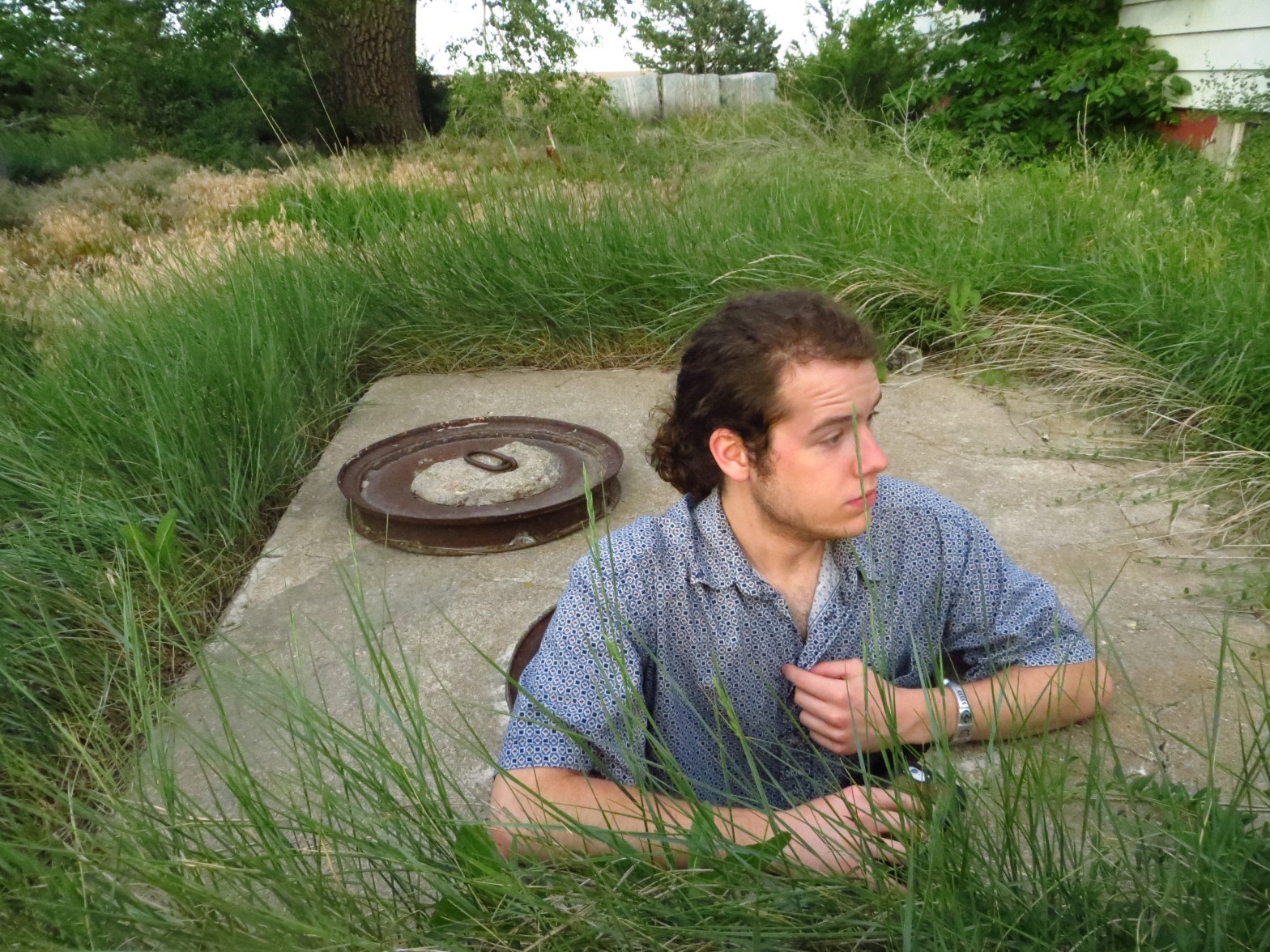
Sometimes we tunneled our bodies right into an embankment, half in and half out, digging with our fingers so as not to scratch the bottles, gently dislodging them from the musky soil, from the flakes of rust and fragments of decomposed wood.  Then we lay there breathing softly, part of the ground itself, delighted by our newest find: Dr. Kilmer’s Swamp Root Remedy or Tone’s Flavoring Extract.  For a moment, we held the aqua and amber containers in quiet awe, marveling that they had been handled by other people who were long gone, just as “poured-out” as these bottles’ contents.  People who had lived whole lives without hearing of television or Atomic bombs or 8-Track cassettes.

***

From dust you were made and to dust you shall return.  That’s a hard one to ignore—if you are right down there in the soil, more conscious than ever of your own mineral make-up.  From dust you were made.  True for us all.  And to dust you shall return.  Also true, but restful in a way.  Like lying in your own bed.   

***

As a child at boarding school, I remember doing a bit of early reflecting in a cave some older boys had dug.  At the end of the soccer pitch, where the flat ground broke away, a round hole opened into the hillside like the mouth of a hundred-gallon barrel. 

I visited it with my friend Danny, the two of us prostrating ourselves on hands and knees and crawling into the entrance like cubs to their den.  More of a tunnel than a cave, it ran back ten or fifteen feet, then bent around a column of earth and came back like a hairpin. 

When we hid in there from friends, Danny and I would whisper and giggle, but we did not truly encounter the place.  Once, though, I forced myself to go alone.  After I had scrambled down the slope, the voices of the playing children faded.  It was quiet enough that I could hear the stream burbling in the ravine below. 

After bowing and peering into the hole, half-expecting a troll to lunge out, I cautiously crawled in. Cool air met me like the air from a fridge.  I paused and waited for my eyes to adjust.  Now I could not hear the soccer players at all, or the stream.  The spadework on the walls looked like a series of broken dinner plates, each fragmented plane a bit darker as it receded into the blackness.  I reached out to the hard clay, which left a silky residue on my fingers.  Here and there, the tendrils of roots, thin and kinky like pubic hair, dangled yellow.  I smelled their mealy mushroom scent. 

     After I crawled deeper, to where the tunnel broke two directions, I could feel the weight of the whole hill on top of me, all that thick clay pulled toward the core of the earth.  I was afraid of its imponderable inertia, but I slid a few feet further, until I was behind the column of earth and couldn’t see the light at the entrance, just a faint glimmer on the spade-chopped walls.  There I held my breath and heard my own blood pumping.  And for the first time in months, I felt completely, utterly alone.  It was terrifying, but it was exciting too.  The sense of my own existence.  The sense of my small but real life.  The sense of me actually thinking. 

***

Hermits live in caves.  Loners and crazies.  But also prophets—like Elijah, who hid away, afraid to prophesy until God surprised him as a whirlwind then an earthquake then a mighty fire, calling him to the mouth of the cave with a final gentle whisper: “What are you doing here, Elijah?” 

***

The Hopi go looking for visions in the earth, descending into a closed pit.  They gather around a cylindrical hole which symbolizes the gateway from the underworld, where their ancestors used to live like lizards, into the upper world, where they emerged as people.  For centuries and centuries, they have gone down into these “kivas” to know themselves, reflecting on their place in the world.  To learn what needs learning. 

***

And what about Alice in her underground “Wonderland”? 

When she fell down that rabbit hole, she saw everything anew.  She fell for hours, it would seem, doing it slow enough to lift a jar of marmalade off a shelf then put it into a cupboard below.   And after she landed, she drank from a bottle that made her shrink to 10 inches, passing through a door that could have been designed for mice.  Only a child, she encountered all manner of paradoxes.  Revelations galore. 

***

To dive into the earth is to see a secret, mysterious realm.   Under the powdery dirt and damp loam dangle the bushy roots and their creepy crawlies: fly larvae, root aphids, mites, nematodes, millipedes, beetles, earthworms, ants, slugs, snails, not to mention snakes, lizards, salamanders, mice, and moles.  And when you come back to the earth’s threshold, half in and half out, you are different.  You are smaller somehow, and everything else is large.  Even the grass, which towers up like trees, screening your sight.  

To come up out of the earth is to be humbled, like the mole or the mouse.  For we are not much larger really, nor important.   But what a marvel to be aware.  To know this truth, if only for a fleeting moment!

The Climbing Lesson

My father always enjoyed moments of goofing around, and he didn’t mind when my brothers and I put him in the middle of our own goofing around. He never took himself too seriously. And that was a lesson in itself. Here is an audio version of the title story from my book Climbing Lessons. Just click here and you will hear how my accident-prone Dad tried, one afternoon when I was in grade school, to show my brothers and me how to climb a massive sycamore!

Freeway Aesthetics, Winter, Iowa

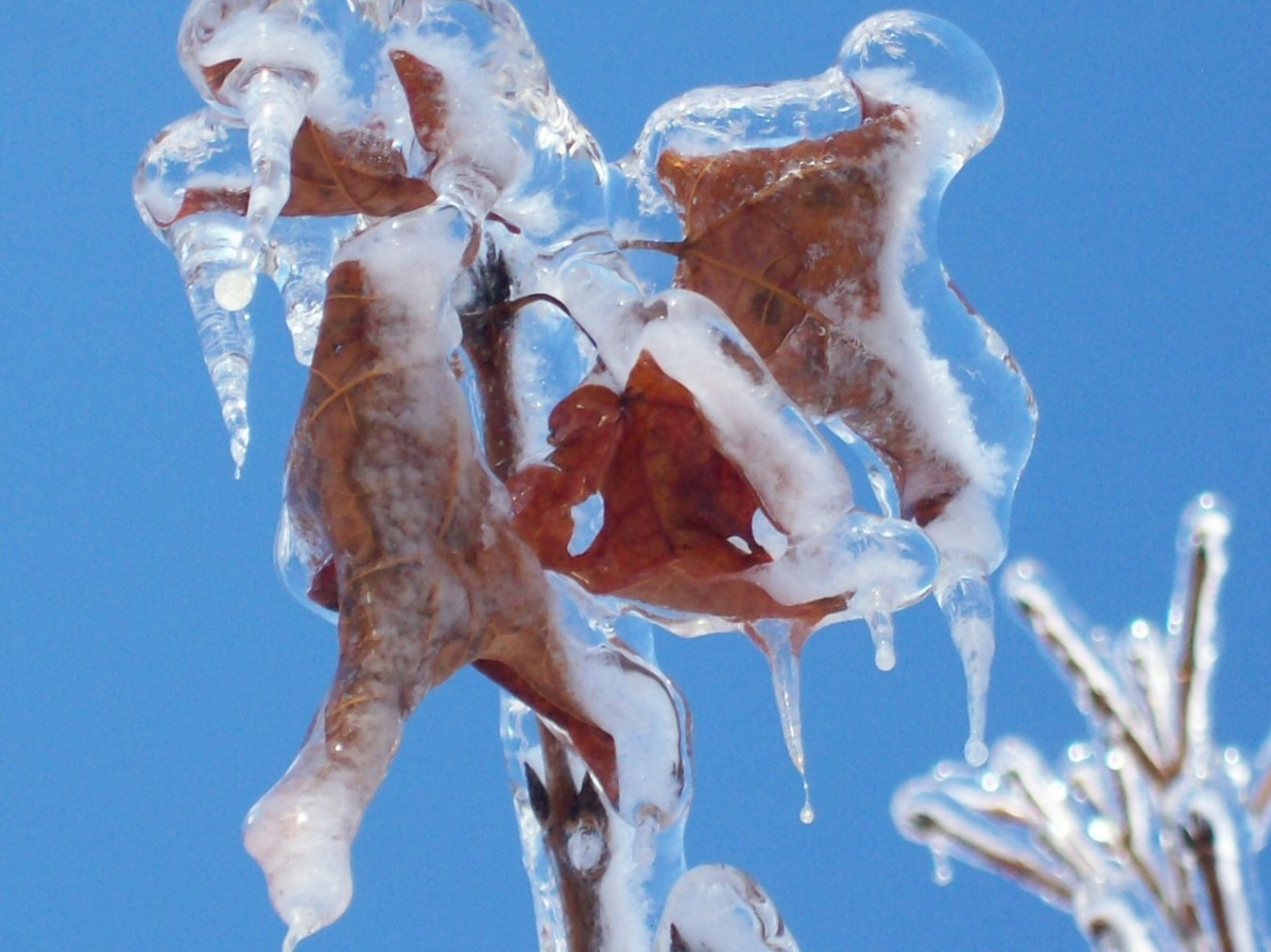
After two days of blowing snow and added sleet, a white, white world of purest white stretches out on both sides of I-35, glistening.  The sun, in the cloudless sky, is white too, as it slides down from the deep blue toward the pale blue, lighting up the sheathed tips of everything—the bushes in the culverts, the distant woods silhouetted against the snow, the windrow fences and roadside grasses and patches of cattails, all crowned with sparkling filaments of ice.  

This is a newly invented world, converted by some ingenious alchemist into a delicate and perfect replica of luminescent glass.  This is a new world of fiber-optic shimmering.  Even the corn stubble in the drifted fields—poking out of upended clods—even this has become beautiful so that it twinkles across the rolling swells, glittering brightest on the white crests, where the lowering sun keeps doing its remarkable White Magic. 

Sublime, I tell you. 

But when did that word fall out of style—and, with it, the notion of celebrating artistic expressions that were purely beautiful?  Something in the spirit of Thomas Cole or Albert Bierstadt?  Expansive, sunlit landscapes that fill the viewer with delight and awe?

Is anyone else noticing this wonder, I wonder, as I shoot south at 79 miles an hour, staying just under the ten-miles-over-the-limit that is guaranteed to result in a traffic ticket.  My son is waiting beside a blues bar in Des Moines, so there is no stopping, but when I look to the girl with purple hair who is also driving south, head bobbing to some unheard tune, I can’t help questioning whether she is seeing what I’m seeing?  Or the gray-bearded farmer with the tarped truckbed?  Or the lean Latino hauling a flagged trailer with an immense earth-moving machine that has wheels large as my Civic?  Are any of them feeling the same urge to break into song?  Are they wanting to call spouses and put it all in words?

I pass a tow-truck driver parked on the slick shoulder, preparing to winch a snow-clotted van out of the ditch.  He is up on the tilted bed, staring.  He takes off his gloves and lifts an I-Phone in the 9-degree cold, bare-fingered, aiming it toward that glistening scape, and when I look back in my rear-view mirror, he is still up there, balanced on the peak of that steep incline, arms raised, trying to capture as much as he can. 

Jet Lag

When I step out of Terminal C of the Kansas City International Airport, I am swaddled in muggy heat.  I feel as if I have stepped into an immense sauna.  Part of me wants to strip right there.

It’s almost July, and the weather is what one might expect.  However, I am no longer in sync with what one might expect.  For the past two and half weeks I have been far, far away, in the highlands of Kenya and Ethiopia, where the temperature was a mild 60 or 70 degrees Fahrenheit, dropping down into the 50’s at night.  Even though I was near the equator, the high altitude and the occasional rains shifted me into a kind of tropical winter, wearing a jacket against the morning chill, drinking tea to warm my bones, shedding my outer layer as the sun climbed to its zenith. 

The air was so thin and clear in Kenya and Ethiopia that sunlight fell directly onto my skin, doing a pleasant slow-burn.  Instead of swaddling me, thick and wet, it settled on my arms like powder.  It had a different tint as well—more diffused, not as densely white.  Thin and transparent as water-color, it didn’t glare in a Midwestern lead-white way, causing my eyes to ache.  It didn’t slant heavily either.  Here, when I look around, everything has hard-edged shadows underneath—the airport shuttle and the passengers with pull-along suitcases—but those shadows seem a kilter.  The sky needs to be re-aligned, it seems.  Or maybe me? 

My wife and I find our Honda and drive north toward home, headed up 1-35, but the sensory disorientation continues, as if I have been sucked out of my true body then injected into someone else’s. 

Everything is so neatly organized here—the square lawns with their right-angle sidewalks, the criss-cross parking lots, the rectangular shop fronts, the boxed-in fields with their perfectly parallel croplines, even the endless electric lines in their aerial grid.  It’s as if the scene is entirely machine-made, which (now that I think of it) is exactly the case, since machines laid down the concrete and built up the structures, and since machines processed all the poles and wires that got stretched in mathematical precision across the land. 

East Africa was so organic by comparison—paths that wound every which way, braided over the top of each other; donkeys straying onto the highway; asymmetric vending stalls built of mismatched poles; little patchwork fields in crazy-quilt patterns.  To look out at that landscape was to be constantly surprised.  Nothing was predictable—unlike here, where one could almost tie the steering wheel in place and go to sleep, waking to find everything looking the same. 

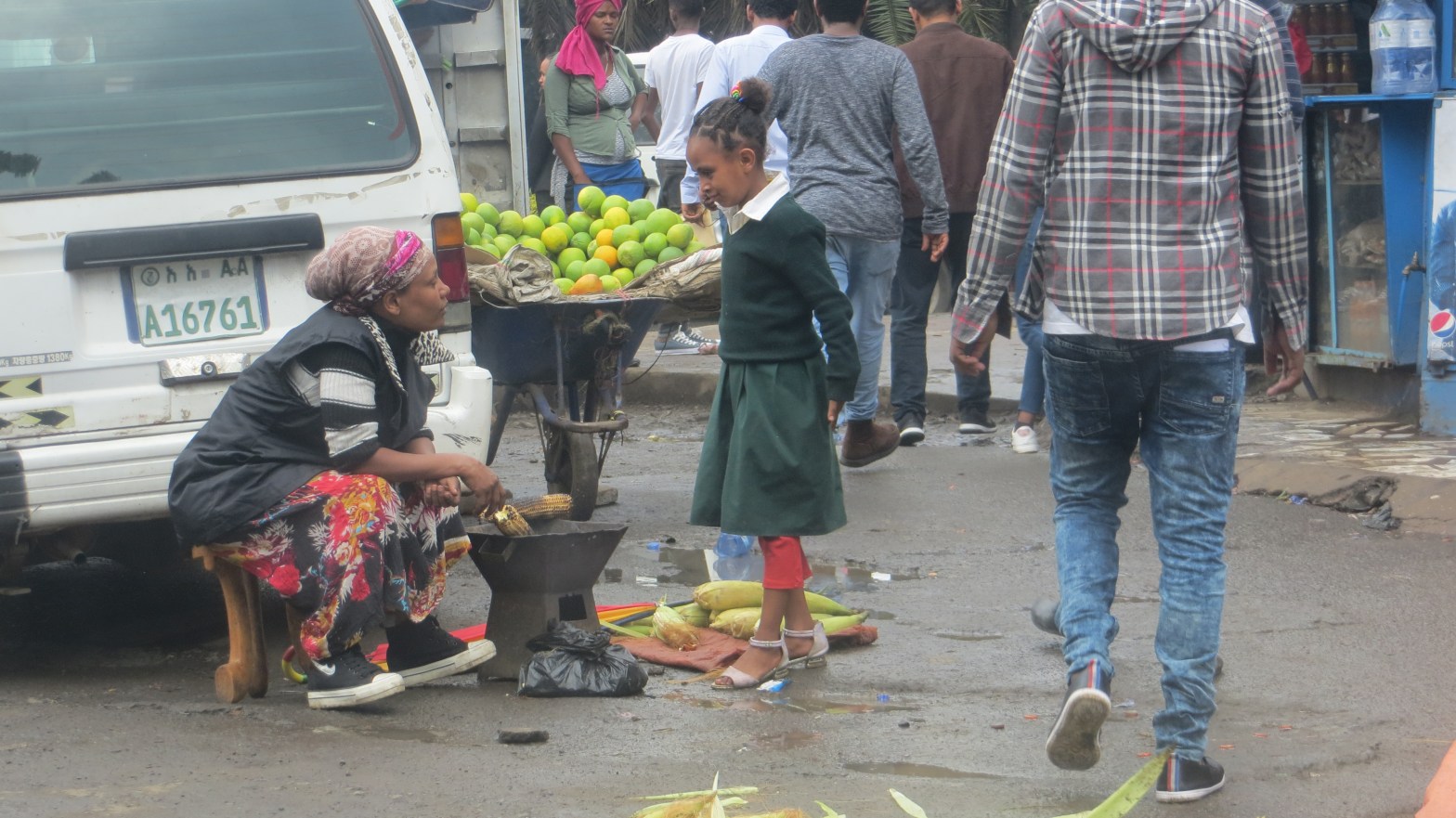
And where are the people?  So much space to inhabit but so few faces.  In Kenya and Ethiopia, one couldn’t drive a hundred yards without seeing someone, if not a crowd.  In the towns, shop attendants threw pails of soapy water into the roadside ditches and construction workers hoisted planks on a pulley and mechanics leaned into the bowels of parked trucks.  Farmwives carried burlap bags of greens to the market and lawn workers swung machetes at the receding grass and Arab truck drivers drank chai under awnings and schoolgirls giggled in red sweaters and legless beggars humped along, swinging their torsos on dirty hands. 

In the countryside, the people would ebb.  But even out on the open savannah, one could still see herders taking goats to pasture or farmers guiding heavy-laden donkeys.  One could see locals hiking red-dirt paths along the edge of zig-zag fields, getting from point A to point B in the way they have always gotten from point A to point B.  Or one could see a lone boy lying on the ground, face-up, staring into the sky. 

Here, though, no one!  Not even as we get to the first big city—Des Moines—and swoop past a commercial zone, where one is confronted by the glint of hundreds of glassed-in cars and whole blocks of air-conditioned glass.  Nary a face, except a hitchhiker standing in the shade of an overpass, looking at his map.  Passing by, I feel like he and I are the only outliers left in this post-modern ghost town.  Though I have driven the same route dozens of times, I have been turned into a stranger. 

North of Des Moines, I look to the fields again, and though I see a couple of cows in a pasture, I drive twenty minutes without sighting a human.  Miles and miles of corn slide past, but no one switching a donkey or selling mangoes.  No farmers pulling weeds. And certainly no boy lying on his back, staring at clouds. 

This Midwestern landscape is “picture perfect” in a fertile, controlled way.  It’s a well-kept, bucolic painting of the landscape-architecture genre.  But it feels sterile to me now, the man who has returned from the other side of the globe. 

When the sun sets and darkness settles over northern Iowa, I pass the town of Clear Lake with its intersecting lines of lights.  I am almost home now—to the little burg of Forest City—and I am dead-tired, having jumped eight time zones in twenty hours.  In Ethiopia it must be five or six a.m.—the time when the roosters begin to crow and the muezzin clears his throat for prayer.  Over there, everything is beginning anew.  But here I drive toward a cul-de-sac of old routines, taking the off-ramp and following hypnotic dashes toward a dark habitual house that will close around me predictably, saying “I knew you would come back.  Sleep now.” 

I unlock the door and fall into bed, returning to the cessation of movement, to the unconscious stasis of a life I used to live—a life that is simultaneously familiar and very strange. 

A Beautiful Crowd

At noon, we throw no shadows.  At noon, we are what we are.  Each one pinned to his or her own ground.  Separate as hell.  But look how we stretch over time.  The sun lowers and we step away.  What slender reaching figures we become, each turned into something new and mysterious and gracefully elongated.  Each exploring the surrounding landscape, dipping into the cracks and stretching over the crests and getting closer, closer to whomever might be passing. 

I knew a man once who lived in his car.  A tall, windburnt sixty-year-old with a greasy coat and silver stubble and dirt-lined hands.  A man who made rooms smell like fermenting bananas.  I would drive by him at noon, walking the road to town.  Always alone.  His hair blazing under the midday sun. And I didn’t stop.

But Doug showed up some afternoons at my open office door unannounced. 

His smell arrived in advance.  Then the tentative knock.  “Hello?”

He brought me stories—of a shop clerk who wouldn’t ring him up, of a lawyer who wouldn’t listen, of nuns who thanked him for his donation.  He gave me other stories, handwritten, about the zen-like focus of archery, about the dewy bejeweled spider web in his father’s pasture, about the two thousand mile bike ride he had undertaken as a young man all the way to New Orleans in winter, warming himself at night with a candle. 

In the winter Doug carves spoons.  Every winter, he carves elegant, ladle-like spoons.  It is his way to get through the blistering cold of northern Iowa and the enforced solitude of his Chevy sedan.  Each spoon is unique, made from hand-picked cherry wood or walnut or honey locust.  Each one is carved with its own special design—sometimes angular, sometimes nothing but curves.  He brought me a whole set one winter, rolled up in felt.  After lifting the packet out of his stained army-surplus coat, he unrolled it carefully, setting each spoon down on my desk.  Like little sculptures, those spoons rested there, with their long arching handles and precise oval cups.  Lit up by the late afternoon sun in my window, each threw down its own lovely shadow, a defined mirror image with lithe curves and planes and angles.  Together, I tell you, those spoons made a very beautiful crowd.  Just like you and me and all the others.  We make a beautiful crowd too, if we really stop and look.   

When I reached out to shake Doug’s hand that afternoon, he looked startled.  “I don’t know if you want to do that. I haven’t washed.”  And, to be honest, I didn’t want to shake.  But I did. And I’ve never regretted that decision since.

So Far Away

     From down here they seem so far away–those two-hundred souls vacuum-sealed into an aluminum fuselage and shot across the sky.  And maybe they are up there thinking the same about me and the few microscopic hikers whose bright shirts can be spotted on this tiny trail in the vast expanse of Arches National Park.  Maybe some girl at a window seat has paused her movie to look down, marveling at so much rugged, rocky emptiness then seeing the wriggly trail and thinking how could anyone survive in such hot, hard terrain?  How did the first people even get across?

     I bet she’s thinking that way because it is the way I thought when I was the person in the sky and my own flight was passing over, headed home to Des Moines from California.  I imagine her eating pretzels and drinking Sprite out of a clear plastic cup.  I imagine her about to go back to the screen in front of her—unpausing Marriage Story with Scarlett Johannsen and Adam Driver, who are drifting toward a very urban modern-day divorce, split between the skyscrapers of New York City and the concrete sprawl of Los Angeles.  However, I’ll bet she is thinking, as she turns back to that screen, Amazing–there is still this ginormous area, so rugged and undeveloped that you can actually get lost in it.

     It is hot down here.  Really hot.  105 degrees hot. Which is why my wife and I have taken shelter in the shade between two boulders, huge mushrooms of reddish sandstone perched atop a plate of more sandstone.  I am drinking from a water bottle because I’ve been told to stay hydrated.  I am not conscious of the heat like I might be in the Midwest, where you can feel the corn perspiring as you jog out of town and enter one of those gravel corridors between walls of vegetation.  I am not sweating, and my lungs feel light.  But I’m drinking because my wife insists, “Don’t be stupid.  You need to stay hydrated.” 

      I tip my head back to take another swallow, and there it is: the contrail, so perfectly linear, so machine-made. I suppose I was hearing this jet already, just too accustomed to the sound to register it.  But now, I can see the silver speck and its long thin vapor trail.  Those travelers are so far away, it seems.  Six miles high?  Maybe seven?  However, it occurs to me that, in the 1300’s or 1400’s when Ute hunters came creeping through the sagebrush with their bows, hoping to take down some antelope, those airborne travelers were much, much further away.  And when the Franciscan Fathers Domínguez and Escalante came trekking from Santa Fe in 1776, at the same time the American colonies were gaining independence from Britain, they didn’t hear or see jets.  That’s for sure.  And when the Mormons arrived in 1847, pulling handcarts from Illinois, they weren’t hearing any jets either.  In fact, the first commercial jet airliner was still a century away, which is a lot further than the standard flying altitude of 32,000 feet.    

     Wendell Berry once went hiking in Kentucky’s Red River Gorge, now over fifty years ago, and because he heard a jetliner, he had a terrible vision of how much nature had changed in his lifetime.  Before he was borne, “the continent was still covered by a great ocean of silence, in which the sounds of machinery were scattered at wide intervals of time and space.”  But by the time of his hike, Berry could see that America had become covered, instead, “by an ocean of engine-noise.”  He saw that he did not live, like people of old, on little islands of machine-made civilization.  Instead, wilderness had been reduced to islands, and those little shrinking places were surrounded by an ever-expanding man-made environment. 

     Back in the Midwest, on certain winter days when I am driving down the highway, I become aware of jet contrails because they are more visible due to the frozen condensation behind the engines, and I actually start counting. I think my highest number is 15, but on almost any day I can see at least two or three contrails.  No surprise, I guess, given that there are 90,000 flights in the air every day now, crisscrossing the globe. 

     Is there anywhere they don’t go?  I’m not sure, but I do remember personally flying past Mt. Everest on the way to Nepal and I remember thinking, Hey, someone might be standing on the peak right now, savoring his or her moment of grand accomplishment.  Someone may have just joined that elite mountain-climbing club, going where almost no human ever goes, and that person may be looking over at us, flying five thousand feet higher and sipping Chardonnay, and if so, what is that climber thinking? 

     To be honest, I was glad to see Mt. Everest from the plane.  Now I could say I had actually seen it myself.  But it also felt wrong, too easy really—like something I had purchased without earning.    

     Others were getting up in the aisle and taking photos, but I didn’t.  I think I knew instinctively that Everest would never be Everest if seen from so far above. 

     Here, though, in the shadow of these boulders, where the Utes used to migrate through and where 18th Century Spanish explorers came along and then a 19th Century intrepid American named Frémont who lived before the era of cameras and could only record notes to take back to the waiting public, here I take out my little digital camera.  I aim it up, and click.