Featured

A Beautiful Crowd

At noon, we throw no shadows.  At noon, we are what we are.  Each one pinned to his or her own ground.  Separate as hell.  But look how we stretch over time.  The sun lowers and we step away.  What slender reaching figures we become, each turned into something new and mysterious and gracefully elongated.  Each exploring the surrounding landscape, dipping into the cracks and stretching over the crests and getting closer, closer to whomever might be passing. 

I knew a man once who lived in his car.  A tall, windburnt sixty-year-old with a greasy coat and silver stubble and dirt-lined hands.  A man who made rooms smell like fermenting bananas.  I would drive by him at noon, walking the road to town.  Always alone.  His hair blazing under the midday sun. And I didn’t stop.

But Doug showed up some afternoons at my open office door unannounced. 

His smell arrived in advance.  Then the tentative knock.  “Hello?”

He brought me stories—of a shop clerk who wouldn’t ring him up, of a lawyer who wouldn’t listen, of nuns who thanked him for his donation.  He gave me other stories, handwritten, about the zen-like focus of archery, about the dewy bejeweled spider web in his father’s pasture, about the two thousand mile bike ride he had undertaken as a young man all the way to New Orleans in winter, warming himself at night with a candle. 

In the winter Doug carves spoons.  Every winter, he carves elegant, ladle-like spoons.  It is his way to get through the blistering cold of northern Iowa and the enforced solitude of his Chevy sedan.  Each spoon is unique, made from hand-picked cherry wood or walnut or honey locust.  Each one is carved with its own special design—sometimes angular, sometimes nothing but curves.  He brought me a whole set one winter, rolled up in felt.  After lifting the packet out of his stained army-surplus coat, he unrolled it carefully, setting each spoon down on my desk.  Like little sculptures, those spoons rested there, with their long arching handles and precise oval cups.  Lit up by the late afternoon sun in my window, each threw down its own lovely shadow, a defined mirror image with lithe curves and planes and angles.  Together, I tell you, those spoons made a very beautiful crowd.  Just like you and me and all the others.  We make a beautiful crowd too, if we really stop and look.   

When I reached out to shake Doug’s hand that afternoon, he looked startled.  “I don’t know if you want to do that. I haven’t washed.”  And, to be honest, I didn’t want to shake.  But I did. And I’ve never regretted that decision since.

Featured

So Far Away

     From down here they seem so far away–those two-hundred souls vacuum-sealed into an aluminum fuselage and shot across the sky.  And maybe they are up there thinking the same about me and the few microscopic hikers whose bright shirts can be spotted on this tiny trail in the vast expanse of Arches National Park.  Maybe some girl at a window seat has paused her movie to look down, marveling at so much rugged, rocky emptiness then seeing the wriggly trail and thinking how could anyone survive in such hot, hard terrain?  How did the first people even get across?

     I bet she’s thinking that way because it is the way I thought when I was the person in the sky and my own flight was passing over, headed home to Des Moines from California.  I imagine her eating pretzels and drinking Sprite out of a clear plastic cup.  I imagine her about to go back to the screen in front of her—unpausing Marriage Story with Scarlett Johannsen and Adam Driver, who are drifting toward a very urban modern-day divorce, split between the skyscrapers of New York City and the concrete sprawl of Los Angeles.  However, I’ll bet she is thinking, as she turns back to that screen, Amazing–there is still this ginormous area, so rugged and undeveloped that you can actually get lost in it.

     It is hot down here.  Really hot.  105 degrees hot. Which is why my wife and I have taken shelter in the shade between two boulders, huge mushrooms of reddish sandstone perched atop a plate of more sandstone.  I am drinking from a water bottle because I’ve been told to stay hydrated.  I am not conscious of the heat like I might be in the Midwest, where you can feel the corn perspiring as you jog out of town and enter one of those gravel corridors between walls of vegetation.  I am not sweating, and my lungs feel light.  But I’m drinking because my wife insists, “Don’t be stupid.  You need to stay hydrated.” 

      I tip my head back to take another swallow, and there it is: the contrail, so perfectly linear, so machine-made. I suppose I was hearing this jet already, just too accustomed to the sound to register it.  But now, I can see the silver speck and its long thin vapor trail.  Those travelers are so far away, it seems.  Six miles high?  Maybe seven?  However, it occurs to me that, in the 1300’s or 1400’s when Ute hunters came creeping through the sagebrush with their bows, hoping to take down some antelope, those airborne travelers were much, much further away.  And when the Franciscan Fathers Domínguez and Escalante came trekking from Santa Fe in 1776, at the same time the American colonies were gaining independence from Britain, they didn’t hear or see jets.  That’s for sure.  And when the Mormons arrived in 1847, pulling handcarts from Illinois, they weren’t hearing any jets either.  In fact, the first commercial jet airliner was still a century away, which is a lot further than the standard flying altitude of 32,000 feet.    

     Wendell Berry once went hiking in Kentucky’s Red River Gorge, now over fifty years ago, and because he heard a jetliner, he had a terrible vision of how much nature had changed in his lifetime.  Before he was borne, “the continent was still covered by a great ocean of silence, in which the sounds of machinery were scattered at wide intervals of time and space.”  But by the time of his hike, Berry could see that America had become covered, instead, “by an ocean of engine-noise.”  He saw that he did not live, like people of old, on little islands of machine-made civilization.  Instead, wilderness had been reduced to islands, and those little shrinking places were surrounded by an ever-expanding man-made environment. 

     Back in the Midwest, on certain winter days when I am driving down the highway, I become aware of jet contrails because they are more visible due to the frozen condensation behind the engines, and I actually start counting. I think my highest number is 15, but on almost any day I can see at least two or three contrails.  No surprise, I guess, given that there are 90,000 flights in the air every day now, crisscrossing the globe. 

     Is there anywhere they don’t go?  I’m not sure, but I do remember personally flying past Mt. Everest on the way to Nepal and I remember thinking, Hey, someone might be standing on the peak right now, savoring his or her moment of grand accomplishment.  Someone may have just joined that elite mountain-climbing club, going where almost no human ever goes, and that person may be looking over at us, flying five thousand feet higher and sipping Chardonnay, and if so, what is that climber thinking? 

     To be honest, I was glad to see Mt. Everest from the plane.  Now I could say I had actually seen it myself.  But it also felt wrong, too easy really—like something I had purchased without earning.    

     Others were getting up in the aisle and taking photos, but I didn’t.  I think I knew instinctively that Everest would never be Everest if seen from so far above. 

     Here, though, in the shadow of these boulders, where the Utes used to migrate through and where 18th Century Spanish explorers came along and then a 19th Century intrepid American named Frémont who lived before the era of cameras and could only record notes to take back to the waiting public, here I take out my little digital camera.  I aim it up, and click. 

The Messenger

If you have ever seen a remarkable bird–so remarkable that it practically paralyzed you with fascination–then you will relate to this new essay from the journal Under the Sun. In “The Messenger” I am thinking out loud about the wonder of birds, about God, about aging, about the continued desire for transcendence. Here’s the link: https://underthesunonline.com/wordpress/2023/the-messenger/

Tunnel of Love

Certain pieces of art stay with you forever, like the hum of a tuning fork.   Typically, such pieces are the invention of a solo genius like Rembrandt or Picasso.   We associate them with contemplative solitude and silence.  However, one art piece which had a profound impact on me was made by a whole cooperative.  A group of collaborators from Austria and Croatia worked with thousands of feet of clear packing tape to create a complex of airborne tunnels stretching across an expansive exhibit hall.   The translucent set of interconnected tunnels, like something made by a giant silkworm, picked up light from high windows, glowing as if they were a vast network of fluorescent tubes floating overhead.   Even better, they were strong enough that people could ascend a custom-made staircase and climb right into them, crawling through the air, suspended 10 or 15 feet above the concrete floor. 

Rarely have I seen people—not just children but full-grown adults—as happy as the ones who came back down those makeshift stairs.  Rarely have I felt more happy myself, than after my wife and I had removed our shoes and car keys and crawled into that airy, light-filled warren, easing along the twisted corridors of light, with the muffled voices of viewers commenting from below. 

My wife and I parted ways at a fork in the interconnected tunnels then came back together at another fork, face-to-face in the white shimmering light, and she was lovely there, in her giddy delight.   Any fatigue or guardedness was gone as she grinned in sheer amazement.  I could see, in her eyes, what I was feeling.  Total enchantment. 

But why?  Why was this odd aerial invention so compelling?   

Some of the pleasure, I surmise, was due to a return to childhood.  We were like kids who were getting to float through their first amusement-park tunnel, simply fascinated by the sheer novelty of what we experienced.  Plus, the tunnels were big enough to make us feel small again.  They dwarfed us, bringing back the awe of experiencing something much larger than ourselves. 

Some of the pleasure also came from the ephemeral beauty of the gossamer material.  Nothing but long strands of clear packing tape, layer after layer.   Who would have guessed?

But there is another, harder-to-define dimension to this remembered pleasure.  I see now, looking back, that much of the delight was due to having simply shared the experience.  My wife’s smile echoed my own.  My happiness reinforced hers.  The two of us were in complete agreement about something we both instinctively loved. 

Encounters with art can be amazing no matter who is around.  However, I am convinced that they get magnified if shared with someone who is deeply known and cared for.  When such a person sees what you are seeing and echoes it back, then suddenly it is twice as remarkable.  It rises to another level, as if lifted from speech to song.

Fifteen years have passed, and more will pass I’m sure, but Cathleen and I will keep on remembering that transcendent, glowing piece made by a whole troupe of interweaving artists who sang it into being, giving it brief, glimmering shape, lifted up in the air like a bridge of astonished sighs.  It was a temporary installation, but it has become permanent for us.

A Fun List of My Favorites

I’m enthused that my first memoir–Chameleon Days–has been included on the growing shepherd.com website, which brings together lists of related books. If you have any interest in first-person accounts of expatriate life in Africa, here are a few of my favorites, now featured on their website. Simply click here: https://shepherd.com/best-books/memoirs-of-american-and-european-expats-in-africa

Equine Therapy

When I think of horses, I tend to think of them groomed and saddled.  I think of them as domesticated or “broken,” as the cowboys used to say in old-fashioned Westerns. 

Those “tame” horses would open their mouths to the bit, which caught under their tongue or clunked against molars.  They might sidle as the saddle was swung onto their backs, but they stood patiently as I swung into riding position.  And they could be maneuvered.  A cluck and off they went.  A tug of the reins and they stopped, even backed up. 

They were fun to sit upon, especially since I sat upon them so rarely and back when everything was still brand new, such as the muscular sway between my legs, the bristly curve of the neck as they turned, the musky odor of fermenting hay after they cantered, but mainly the amazing sense of being in control of something so large and foreign.  A creature under my command.  “My horse,” even if only rented.  

Once, though, all horses were wild, not tame.  They lived like wildebeest in a game park, only freer.  Migrating as a herd.  Kicking up their heels.  Fleeing any predator, whether wolf or human. 

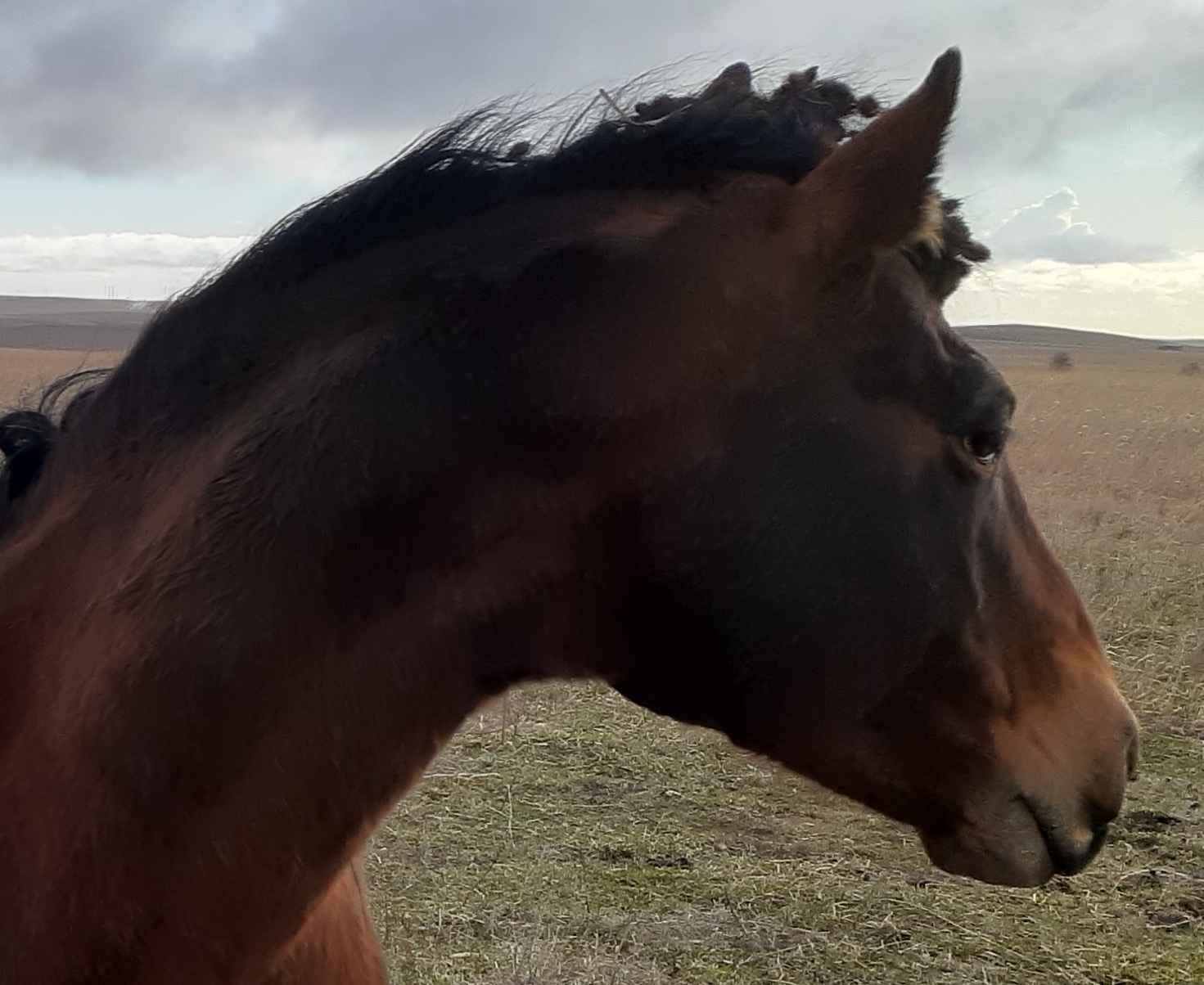
An encounter with two horses on the Flint Hills in Kansas woke me to this fact.  The pair I spotted must have been around humans occasionally, or they would not have grazed right toward me when, after parking on a highway pull-off, I walked to the corner of the fence on an immense prairie. 

They were not afraid of me.  Just curious.  But the hundreds of acorn-sized burrs tangled in their manes suggested they were, in essence, feral.  Months of open grazing, whole months of poking their heads into brushy ravines, had created dreadlocks of knotted burrs, and clearly no human had taken time to pick those burrs away. 

The unrestricted freedom of the two horses made me aware that all horses are, prior to training, simply animals.  They are not our transport devices or tools.  They are not our showpieces.  They are as wild and instinctive as muskrats or coyotes or white-tail deer. 

Of course, we are just animals too, in some sense, even though we have so many accoutrements: tennis shoes, bras, cellphones, hand sanitizer, bugspray, lipstick, bottled pop, M&M’s, checkbooks, watches, cigarette lighters, condoms.  We are so busy controlling the world with all this stuff—making sure we stay warm, safe, entertained, and on time—that we forget we are just animals too.  For us, nature seems distant, when in fact it is as close as our fingertips.

Once we were not so domesticated ourselves.  We slept with nightfall and woke with the rising sun.  We ate only what was available in that season or what had been carefully preserved using the simplest of methods—heat and salt.   We bathed rarely and drank straight from streams.  We burned dung as fuel.  We adorned ourselves with clay and feathers.  We thanked God for each creature that had died so that we could be fed. 

When I finally reached out on that prairie hill and stroked the big, ruminating jaw of the nearest horse, a bay mare, and when her eyes widened in response, it was as if all that lost reality came tumbling back.  In that moment, nothing existed between me and her.  The two of us were brother and sister.

Wave Theory

Coming down the steep zigzag trail in the forest, terra firma is still underfoot, and though the stairstepped Pacific-coast pines are quite different than the cottonwoods of our midwestern plains, they are still trees and we are still ourselves, a family living in a slightly heightened but normal state, minds prone to distraction—cellphone texts, baggies of trail mix, yesterday’s quarrels.  

On the beach, though, all distractions fall away.   There are no deadlines or commitments.  The waves come and go, come and go, hushing the internal racket.  They chant an unfamiliar yet familiar mantra—say the same thing until it is everything:  Be here, shshsh.  Now, shshsh.  Here, shshsh.

Even as we stand on the sand, gazing toward Asia, the waves take us out with them.  We float away on the rhythmic, rise-and-fall breath-of-the-planet.   

Earth, air, water, all come together here on the Oregon shore, chilly under gray hovering clouds.  And those three primal elements conjure up the fourth, glowing in the soul.  Near naked, we dive into the waves.  They swallow us up, too frigid for thought.  But when we step out, we are candle flames in our skin.  Alight.  Utterly alive.  We are a united chorus singing the same glad old song. 

Wave Theory

Coming down the steep zigzag trail in the forest, terra firma is still underfoot, and though the stairstepped Pacific-coast pines are quite different than the cottonwoods of our midwestern plains, they are still trees and we are still ourselves, a family living in a slightly heightened but normal state, minds prone to distraction—cellphone texts, baggies of trail mix, yesterday’s quarrels.  

On the beach, though, all distractions fall away.   There are no deadlines or commitments.  The waves come and go, come and go, hushing the internal racket.  They chant an unfamiliar yet familiar mantra—say the same thing until it is everything:  Be here, shshsh.  Now, shshsh.  Here, shshsh.

Even as we stand on the sand, gazing toward Asia, the waves take us out with them.  We float away on the rhythmic, rise-and-fall breath-of-the-planet.   

Earth, air, water, all come together here on the Oregon shore, chilly under gray hovering clouds.  And those three primal elements conjure up the fourth, glowing in the soul.  Near naked, we dive into the waves.  They swallow us up, too frigid for thought.  But when we step out, we are candle flames in our skin.  Alight.  Utterly alive.  We are a united chorus singing the same glad old song. 

Hey, Who Do You Think You Are?

When our sons were little, we provided them with a wooden chest full of random costumes, which is how we ended up being confronted in the kitchen by a buxomy matron in high heels or a helicopter pilot behind a tinted visor or a pirate of the most eclectic sort, one who wore a wide-brimmed gardening hat and a cheerful yellow Boy Scout kerchief that might be associated with the slogan “Do a good turn daily.” 

By the way, the plastic eye patch—a very necessary accoutrement for pirating—had an imprinted knife to help instill fear, but the outline of that faux knife hid little open slots so that whoever was wearing it could surreptitiously peer out and get added pleasure from duping everyone.  Which reminds me now of the feeling I used to get, as a trick-or-treater in the 1970’s, whenever I donned one of the cheap molded-plastic masks we found at the toy store in St. Joseph, Missouri.   I used to get such a weird, rare pleasure from wandering the streets of our little town, sniffing the chemicals of the plastic against my nose and hearing my voice muffled by the too-small mouth-hole and peering out through the eye holes to determine how well I had erased myself, becoming someone new.

One year, I was an old-fashioned European organ grinder with a long mustachioed mask, a checkered vest, and a Jack-in-the-Box as my substitute organ.  I also had my little brother on a tether, hidden inside his own rubber monkey mask, a stretchy thing that sagged into his face and had to be readjusted.   To simulate organ music, I would turn the knob on the Jack in the Box—until the Jack would leap out, which would throw my squatting brother into a paroxysm of screeches and bent-knee hops, tugging at the tether while a haphazard mop of synthetic black hair flapped around his monkey face.

It was theater.  It was a role and an act.  I knew that.  But for a bit, I was invested in being something “other” and wanted to do it well.  To really BE the organ grinder.  I wanted Nat to really BE the monkey, too.  Just like my own son must have really wanted to BE the pirate. 

He set his teeth in a snarl.  He squinted out of his one good eye.  Never mind the smooth chubby cheeks, the flawless skin, the sheen of his clean bangs.  Never mind the misplaced band of the eyepatch, which should have been above his eye, not under.  This was a tough guy—to be feared and avoided at all costs.  Photographer beware!      

Back then, when Luke was just a toddler, he threw himself into spontaneous, unrestricted make-believe.  He was not set in his roles.  He had not yet discovered that he was such a softy he would actually quit trying to score goals when the other soccer team fell too far behind.  He did not know that he was too sympathetic to pillage anyone for anything more costly than a cookie.  

It all seemed quite removed from reality, therefore charming.  However, I wonder now whether the impromptu acting was preparing Luke in some subtle way.  Preparing his tender heart for those moments when one sympathy would have to outweigh another.  Maybe he was already getting ready for the moment—twenty years later, during a Black Lives Matter protest—when the crowd around him stopped waving placards and shouting, not sure what to do as the police started to tackle people, knocking them to the ground.

When I was little, I experimented without knowing I experimented.  Anything was possible.  I put the costume on and donned the mask and, for a bit, became.  Never mind my falsetto 10-year-old voice or the fake organ with its Pop-Goes-the-Weasel tune.  I could measure my success simply enough—based on the grins from old people who opened their glass storm doors and dropped Tootsie Rolls into the bag.     

Who knows, though.  Maybe I was, in some sense, trying out what I actually wanted and, in the process, learning a bit more about who I was.  Part organ grinder.  Happy to entertain—to do a bit of song and dance. 

As for son Luke, perhaps he was learning that, although he was not the sort of pirate who would steal, he might, if needed, become a tough guy.  Maybe he was practicing how to stand his ground. 

I am sixty now, and I have put away almost all the costumes and props.  It is tempting, with age, to think I know who I am.  At this point in life, people don’t tend to spend much time outside the prescribed limits they have given themselves.  They don’t want to “waste” the invested effort that has gone into narrowing their focus and energies.  They feel practically obligated to maintain a solid, defined identity. 

But what if they have simply gotten used to old habits?  What if there is still more to be learned?

My grandmother was over 60 when she began oil painting, becoming quite accomplished.  My father, a half-deaf retired doctor, was at least 65 when he started to take Arabic classes at the university.  Jimmy Carter’s mother was 68 when she joined the Peace Corps and left Plains, Georgia to help lepers in India. 

So who knows.  Maybe there is still room to dress up now and then, trying out an unexpected role.  To play make-believe once again.  Which certainly seems more fun than being locked into what might be expected—what has become an assumed way of being. 

Hey, Who Do You Think You Are?

When our sons were little, we provided them with a wooden chest full of random costumes, which is how we ended up being confronted in the kitchen by a buxomy matron in high heels or a helicopter pilot behind a tinted visor or a pirate of the most eclectic sort, one who wore a wide-brimmed gardening hat and a cheerful yellow Boy Scout kerchief that might be associated with the slogan “Do a good turn daily.” 

By the way, the plastic eye patch—a very necessary accoutrement for pirating—had an imprinted knife to help instill fear, but the outline of that faux knife hid little open slots so that whoever was wearing it could surreptitiously peer out and get added pleasure from duping everyone.  Which reminds me now of the feeling I used to get, as a trick-or-treater in the 1970’s, whenever I donned one of the cheap molded-plastic masks we found at the toy store in St. Joseph, Missouri.   I used to get such a weird, rare pleasure from wandering the streets of our little town, sniffing the chemicals of the plastic against my nose and hearing my voice muffled by the too-small mouth-hole and peering out through the eye holes to determine how well I had erased myself, becoming someone new.

One year, I was an old-fashioned European organ grinder with a long mustachioed mask, a checkered vest, and a Jack-in-the-Box as my substitute organ.  I also had my little brother on a tether, hidden inside his own rubber monkey mask, a stretchy thing that sagged into his face and had to be readjusted.   To simulate organ music, I would turn the knob on the Jack in the Box—until the Jack would leap out, which would throw my squatting brother into a paroxysm of screeches and bent-knee hops, tugging at the tether while a haphazard mop of synthetic black hair flapped around his monkey face.

It was theater.  It was a role and an act.  I knew that.  But for a bit, I was invested in being something “other” and wanted to do it well.  To really BE the organ grinder.  I wanted Nat to really BE the monkey, too.  Just like my own son must have really wanted to BE the pirate. 

He set his teeth in a snarl.  He squinted out of his one good eye.  Never mind the smooth chubby cheeks, the flawless skin, the sheen of his clean bangs.  Never mind the misplaced band of the eyepatch, which should have been above his eye, not under.  This was a tough guy—to be feared and avoided at all costs.  Photographer beware!      

Back then, when Luke was just a toddler, he threw himself into spontaneous, unrestricted make-believe.  He was not set in his roles.  He had not yet discovered that he was such a softy he would actually quit trying to score goals when the other soccer team fell too far behind.  He did not know that he was too sympathetic to pillage anyone for anything more costly than a cookie.  

It all seemed quite removed from reality, therefore charming.  However, I wonder now whether the impromptu acting was preparing Luke in some subtle way.  Preparing his tender heart for those moments when one sympathy would have to outweigh another.  Maybe he was already getting ready for the moment—twenty years later, during a Black Lives Matter protest—when the crowd around him stopped waving placards and shouting, not sure what to do as the police started to tackle people, knocking them to the ground.

When I was little, I experimented without knowing I experimented.  Anything was possible.  I put the costume on and donned the mask and, for a bit, became.  Never mind my falsetto 10-year-old voice or the fake organ with its Pop-Goes-the-Weasel tune.  I could measure my success simply enough—based on the grins from old people who opened their glass storm doors and dropped Tootsie Rolls into the bag.     

Who knows, though.  Maybe I was, in some sense, trying out what I actually wanted and, in the process, learning a bit more about who I was.  Part organ grinder.  Happy to entertain—to do a bit of song and dance. 

As for son Luke, perhaps he was learning that, although he was not the sort of pirate who would steal, he might, if needed, become a tough guy.  Maybe he was practicing how to stand his ground. 

I am sixty now, and I have put away almost all the costumes and props.  It is tempting, with age, to think I know who I am.  At this point in life, people don’t tend to spend much time outside the prescribed limits they have given themselves.  They don’t want to “waste” the invested effort that has gone into narrowing their focus and energies.  They feel practically obligated to maintain a solid, defined identity. 

But what if they have simply gotten used to old habits?  What if there is still more to be learned?

My grandmother was over 60 when she began oil painting, becoming quite accomplished.  My father, a half-deaf retired doctor, was at least 65 when he started to take Arabic classes at the university.  Jimmy Carter’s mother was 68 when she joined the Peace Corps and left Plains, Georgia to help lepers in India. 

So who knows.  Maybe there is still room to dress up now and then, trying out an unexpected role.  To play make-believe once again.  Which certainly seems more fun than being locked into what might be expected—what has become an assumed way of being. 

Of Cowboys, Doctors, Tradition, and the Individual Talent

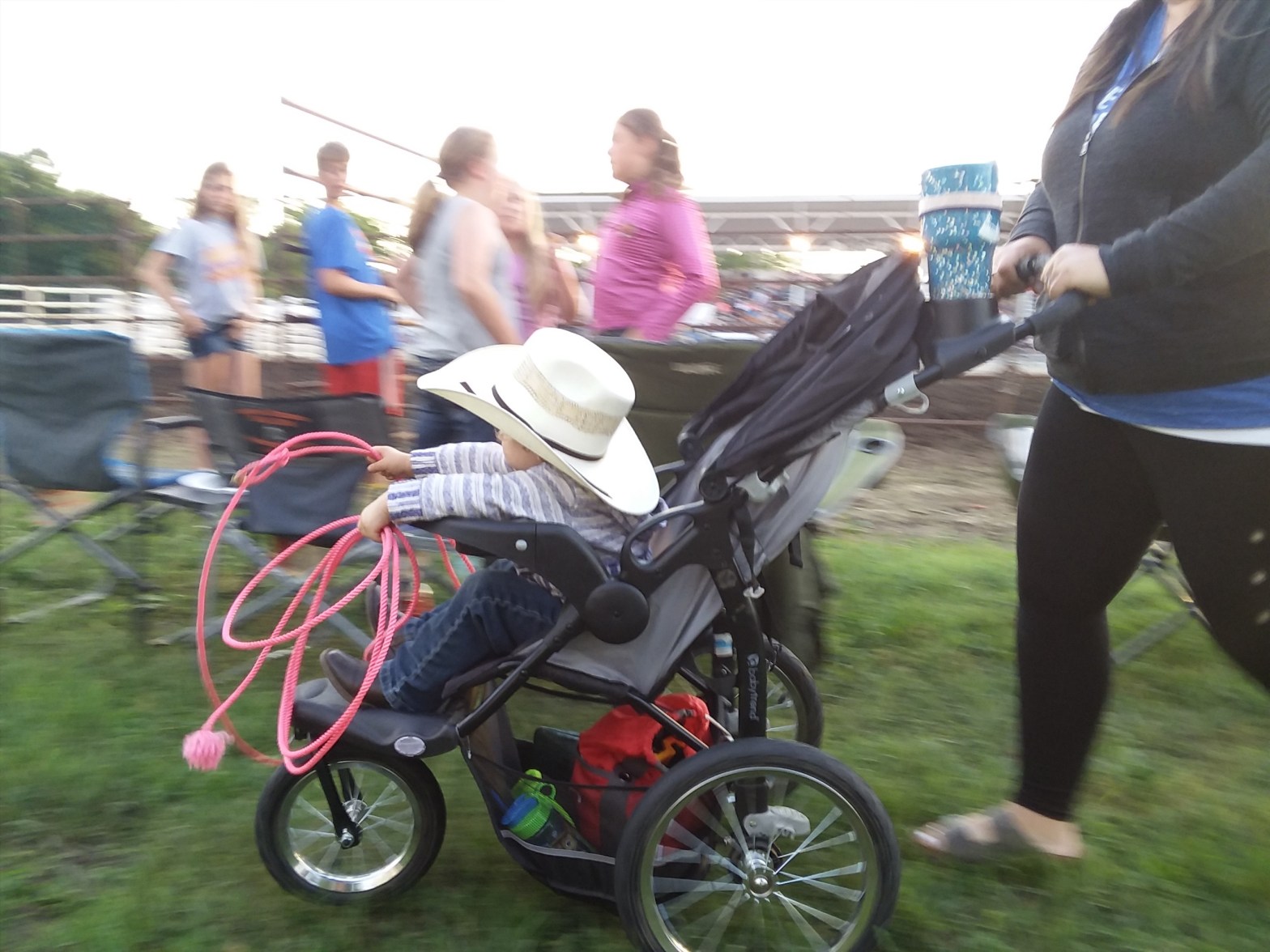
We had walked to the other side of the rodeo, across from the grandstand, so that we could get a closer look at the calves dashing out of the chute and the cowboys galloping after them.  This was where families of the performers hung out, and suddenly my eye was taken by a child being wheeled past in a stroller.  The earnest two-year-old was dressed in shiny boots and jeans and a striped long-sleeved shirt.  He was leaning forward in the saddle of his stroller, gripping a pink lasso in perfect form, right hand on the throwing loop and left on the curled rope.  As he rolled past, I marveled at his eager concentration, as if chasing an invisible moving target.  Oh, I forgot.  He was wearing a stylish white Stetson. 

*         

Ranchers and farmers have a pithy way of saying it:  “Well, I guess the apple don’t fall far from the tree.”  But the poet T.S. Eliot, in his erudite essay on “Tradition and the Individual Talent,” said something quite related.  He argued that, if we can see further than those who came before us, that’s because we stand atop their shoulders. 

                                                            *

My grandfather was a doctor, and he had four sons—all doctors.  What’s more, the eldest had six children who all ended up as doctors or medical professionals.  Until I took college chemistry, I pretty much assumed medicine was my destiny as well.  It felt like a “birthright.”  In fact, I remember dressing up as an 11- or 12-year-old one Halloween, to try out my anticipated role.  I glued a fake mustache under my nose and hung my dad’s stethoscope from my neck and carried my grandfather’s leather medical bag, complete with bottles of outdated pills and syrups.  It felt kind of “natural” to ring doorbells in this guise and to receive the knowing laughter of our small-town, Kansas neighbors. 

                                                            *

No wonder kids follow in the footsteps of parents.  That’s what they see and know.  Plus, they have an automatic advantage, since they get a built-in apprenticeship.  Just look at how many accomplished actors are the children of actors.  Jeff Bridges or Jane Fonda, Michael Douglas or Jamie Lee Curtis, Laura Dern or Kiefer Sutherland, Ben Stiller, Angelina Jolie, Jennifer Aniston, Kate Hudson, or Domhnall Gleeson.  And what pleasure for the proud parents to recognize—in these maturing children—an echo of themselves!

                                                            *

Granddad was certainly proud of his four physician sons.  However, he tended to shake his head when asked how they ALL managed to become doctors, retorting wryly, “Lack of imagination.”  He got laughs from the deflected praise, but I think there is a bit of truth to what he said even if he didn’t realize it.  Doc K.F., as he was known, was a man of admirable duty and demanding expectations, which had its effect.  His sons feared disappointing him, and they were competitive in their attempts to earn his praise.  Whether conscious or not, they each tried to emulate him, and that might explain why, in later years, my father was still questioning why he had become a doctor instead of a farmer or rancher, a way of life that had appealed to him ever since, as a teenager, he had worked at the local dairy barn.

                                                            *

Erik Erickson, the famed developmental psychologist, maintained that young people need to experiment, passing through “identity confusion” so that they can successfully arrive at “identity formation.”  However, if their self-esteem is too dependent on pleasing an authority, they may experience “identity foreclosure.”  They may see no identity but what was preordained.

                                                            *

My father served as a physician his entire adult life—40 years in all, plus a few more in retirement.  He took us to Africa for seven of those years, working as a missionary doctor in remote clinics where he had to improvise—for instance, unraveling a twisted intestine by reading from a propped-up medical guide during impromptu surgery.  He was a bit like a farmer out there in Ethiopia and Sudan, driving a Land Rover on rutted paths, yanking the starting cord on an old diesel generator in the evening, helping to fetch water in barrels.  He was a kind, loving doctor—the sort who listened closely and checked back with patients, wanting to figure out the difficult cases.  But his three brothers always seemed more successful in his estimation. They had gone to Ivy League schools and had become surgeons, not a general practitioner like him.  And his father?  How to match-up to a man who had once been an anatomy professor at the University of Chicago and who had successfully delivered practically every child in Riley County, Kansas?

                                                            *

To Dad’s credit, when I left the pre-med track in college and began to study literature, he was not disappointed.  He supported my interests as I started a career in writing and editing—although he sometimes seemed too supportive during the six years when I worked for a publishing foundation that sent me back into Africa to train writers and editors.  In those years, I could feel the powerful undertow of his worldview and beliefs—his evangelistic, utilitarian understanding of publishing, which went counter to my growing commitment to craft and unvarnished truth.

                                                            *

My turn arrived, and I tried to be supportive of my own sons’ gifts.  However, I can still tell that they sometimes feel a similar undertow coming from me.  Now in their mid-twenties, they push back if I suggest getting a further degree or looking into a certain job opportunity.  They are adamant that they are not like my wife or me, not as concerned with “traditional” careers, me as writer-turned-professor, my wife as Episcopal-priest-turned-bishop.  The youngest is running a political campaign for a woman who wants to be a voice for African Americans on the Des Moines City Council.  After months of protests in the streets and being ignored at city council meetings, he decided he would do what he could to change the system from the inside out.  At the same time, he is writing social justice folksongs.  Meanwhile, the other son is selling Turkmen rugs imported from his girlfriend’s parents in Ashgabat.  And in the free hours, he is peddling his pencil drawings online—healing drawings that, for example, depict Taliban soldiers being transformed into kinder, more-receptive people by blue water-like energy that pours out of the hands of a sheltering Angel Gabriel.    

                                                            *

No, there’s nothing “traditional” about the paths these two young men are exploring!  They are making their own way through the forest.  Except that their chosen paths sometimes appear vaguely familiar in a creative, spiritual sense, seemingly running parallel to my own path and that of my wife.  When I am tempted to call them back toward my route, I have to consciously catch myself.  Sure, I am glad if I can hear them not too far away or when they rejoin me for a bit, walking alongside, but they are 25 and 28 now, and each time they strike off in a different direction again, what is there to say except “Blessings.  Go forth and become.” 

                                                            *

Yes, there’s beauty in tradition, especially when it is chosen, not imposed.  But there’s beauty in diversity too—in the electric individuality of each new person.  Willie Nelson and Waylon Jennings warned mothers, long ago, not to let their babies grow up to be cowboys. They proposed, “let ‘em be doctors and lawyers and such.”  But maybe they should have added, “Don’t MAKE your babies grow up to be cowboys. Don’t MAKE them be doctors either.  Or anything else.”  Maybe Willie and Waylon should have talked to the fathers as well, saying, “Papas, you may have your ideas, but eventually you gotta let them be who they will be.”

In the Mind’s Eye

Imagination.  The ability to picture what is not there.  An alternative reality.  A scenario that blossoms out of the brain, often eclipsing the reality all around.  Just like Ron and Hermione and Harry have eclipsed the school-yard acquaintances of so many children.  Or just like their school, Hogwarts, keeps eclipsing ordinary, “real” schools. 

And what is real really?  Only the provable school pals that you can demonstrate from dated photos in a box of attic keepsakes?  Or the still-looming hulk of a building that you can point to, saying, “I once was lessoned there by a series of chalk-dusted and strict or lenient, normal or quirky, happy or cranky teachers?  Are only those physical, demonstrable realities real? 

What about, instead, the private, emotionally charged memories that remain, shaped by our need to make sense of it all—refracted by the mind, bent, colored, skewed, yet mythically true?  Memories which, by the way, are not that far removed from the purely invented scenarios of Hogwarts—since both exist only in the mind, where we go on imagining all the time, re-creating our version of what “actually” happened or dreaming up what we hope will “actually” occur. 

How important for us to keep imagining like this.  How important to let the mind do its playful thing—to let it roam, going beyond what the body is experiencing, not limited to the confines of what others impose or what we are afraid to risk, not constrained by the mundane clock-in-clock-out demands of conformity, not reduced to a cog in a wheel of the immense machine of duty, not straitjacketed by our skin or sex, not shackled to the ticking second hand of age.  

In the mind’s eye we find not just facts but truth.  We find what is meaningful and free.  In the mind, even the plainest, most lonely child can have a rich life.  In the mind, even the paralytic can run and dive, can fly.